
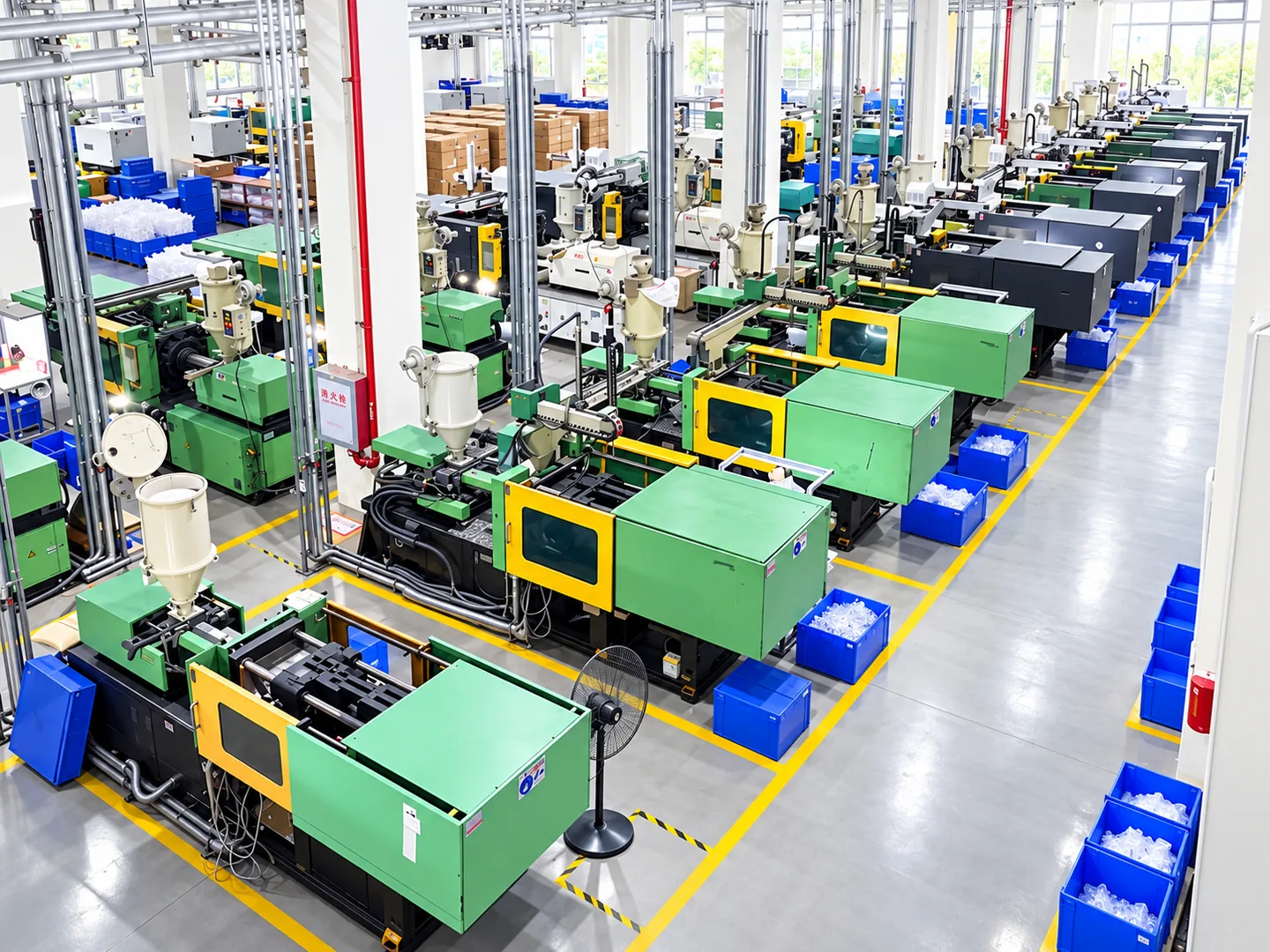
Sourcing a custom plastic part from China is a product-development project, not simply a request for a unit price. A reliable quotation depends on the design files, material, tolerances, appearance, mold concept, expected volume, validation plan, packaging, and commercial responsibilities. The buyer and manufacturer need a controlled path from design review through tooling, samples, approval, and repeat production.
This guide explains how to evaluate a custom plastic parts manufacturer in China and how DFM, in-house mold development, injection molding, and mass production should connect. Kaihang's relevant capabilities are injection molding, in-house injection mold development, OEM and ODM support, and finished-product mass production. CNC equipment is used internally to manufacture mold components, not as a standalone CNC machining service.
For project support based on a drawing, sample, or concept, review Kaihang's OEM and ODM manufacturing process or start an RFQ.
Start with the product requirement
Before contacting a supplier, define what the part must do. Explain the final assembly, user environment, mechanical load, temperature, chemicals, outdoor exposure, expected life, appearance, and consequences of failure. Identify mating components and clarify which interfaces are critical.
A 3D model describes geometry, but it may not explain why a dimension matters. A 2D drawing can identify tolerances and inspection points, but it may not describe assembly behavior. Application context helps the manufacturer distinguish essential requirements from features that can be adjusted for stable molding.
Useful initial information includes:
- 3D CAD model, preferably a usable solid format
- 2D drawing with critical dimensions and tolerances
- Product function and assembly description
- Target resin or required performance
- Color, texture, logo, and appearance standards
- Inserts, labels, fasteners, or secondary operations
- Expected order quantity and annual forecast
- Sample, testing, packing, and destination requirements
If the project starts from an existing sample, state which features must remain unchanged and which may be redesigned. If it starts from a concept, expect an additional product-definition stage before mold quotation.
DFM before mold manufacturing
Design for manufacturability, or DFM, reviews whether the part can be molded consistently and removed from the tool without unacceptable risk. DFM should happen before mold steel is committed, because a small design adjustment can be straightforward in CAD and expensive after tooling begins.
Wall thickness and transitions
Large thickness changes can contribute to sink marks, internal stress, long cooling time, and dimensional variation. A DFM review considers whether walls can be made more consistent and whether ribs or other features can provide stiffness without creating heavy sections.
Draft, undercuts and ejection
Draft helps the molded part release from the tool. Undercuts may require sliders, lifters, collapsible features, or a product redesign. Ejection must support the part without unacceptable marks or deformation. The right approach depends on geometry, resin, finish, and functional surfaces.
Gates, parting lines and weld lines
Gate position affects filling, appearance, trimming, orientation, and potential weld lines. Parting lines influence both tool construction and visible edges. These decisions should be reviewed against functional and cosmetic priorities rather than left as assumptions.
Tolerances and inspection
Not every dimension requires a tight tolerance. Identify dimensions that affect fit, sealing, alignment, safety, or performance. Unnecessarily tight tolerances can increase mold complexity, inspection effort, and production risk without improving the product.
For a deeper file and requirement checklist, see How to Develop a Custom Plastic Product from a Drawing.
Select material from the application
Material selection should begin with functional requirements. Strength, stiffness, impact, temperature, chemical exposure, UV exposure, flame behavior, appearance, color, shrinkage, and cost may all matter. A familiar resin name is not a complete specification; grade, additives, color system, and supplier consistency can change performance and processing.
The buyer should identify mandatory regulatory or market requirements. The manufacturer can discuss processing and application considerations, but responsibility for final product compliance, validation, and market approval must be defined by the project parties.
When comparing suppliers for custom plastic injection molding in China, ask how material identity, drying, color, approved substitutions, regrind policy, and batch traceability will be controlled for the project.
Define the injection mold scope
An injection mold quotation should be based on more than the external part shape. Expected production volume, cavity count, mold material, gate system, undercuts, inserts, surface texture, dimensional requirements, machine range, maintenance expectations, sample stages, ownership, and change control influence the proposal.
In-house mold development
Kaihang develops and maintains injection molds to support approved product-manufacturing programs. The workflow can include mold design, internal CNC machining of mold components, assembly, fitting, trials, adjustment, and maintenance. CNC belongs to this in-house mold-manufacturing process; Kaihang is not positioned as a precision CNC parts supplier.
An importer searching for an injection mold manufacturer in China should confirm how mold design decisions connect to the intended molding machine, resin, cycle, inspection plan, and production forecast. A tool is successful when it supports stable product output, not merely when the first sample can be produced.
Tool ownership and records
Agree on ownership, storage, maintenance, expected tool life assumptions, change authorization, and what happens if the program ends. Keep the approved drawing revision, mold changes, sample approvals, and open deviations in a controlled record.
Review the related guide, How Does Injection Mold Development Work?, before authorizing tooling.
Samples, trials and approval
Initial samples should be evaluated against an agreed plan. Typical review areas include dimensions, assembly, function, material, color, texture, gate and ejection marks, warpage, sink, and packaging behavior. Not every observation requires a mold change; some issues may relate to processing, material, measurement, or the product design itself.
Feedback should reference sample identification and drawing revision. Separate mandatory corrections from preferences and future improvements. When multiple teams are involved, one controlled feedback document reduces contradictory instructions.
Approval should state what has been accepted and what remains open. A visually acceptable sample is not automatically approval of every dimension, load case, regulatory requirement, or long-term performance condition.
Quality planning for mass production
Before mass production, establish the approved sample or specification, incoming material controls, process records, critical dimensions, functional checks, appearance criteria, sampling plan, traceability, packaging, and response to nonconforming output.
The quality plan should focus on product risk. Critical assembly dimensions may require routine measurement, while a noncritical hidden surface may need only visual monitoring. The buyer should supply mating parts, gauges, or test methods when they are needed to confirm fit or function.
For custom injection molded parts, repeatability also depends on controlled revisions. If the buyer changes material, geometry, inserts, mating parts, or acceptance criteria, the effect on the mold and process must be reviewed before the next order.
Moving from pilot production to repeat orders
The transition to mass production should confirm:
- Approved drawing and sample status
- Mold and process readiness
- Material, color, insert, and label specifications
- Inspection and functional test requirements
- Assembly or secondary operations
- Packaging and carton markings
- Order quantity, forecast, and shipment plan
- Change-control contacts and approval authority
Pilot or initial production can reveal handling and assembly conditions that are not obvious during a short mold trial. Record lessons from the first run and incorporate approved changes before repeat orders.
The guide From Prototype to Mass Production covers this transition in more detail.
How to evaluate an OEM plastic parts manufacturer
An OEM plastic parts manufacturer should be evaluated on the complete project path, not on tooling price alone. Ask how the team handles DFM, mold development, material review, sample feedback, production control, packaging, and engineering changes. Confirm which operations are in-house and which are managed through approved partners.
Useful evaluation questions include:
- Can the supplier explain DFM risks in relation to product function?
- Is mold development connected to the planned injection molding process?
- Are sample stages and approval responsibilities defined?
- Can the supplier support the expected production volume and packaging?
- Are critical dimensions and tests clearly understood?
- How are mold changes and product revisions recorded?
- Does the quotation state assumptions and exclusions?
- Can the team communicate technical issues before they affect production?
Kaihang supports OEM and ODM projects that fit its injection molding, in-house mold development, and mass-production capabilities. Projects are reviewed from drawings, samples, or concepts, with quotation based on the actual scope.
Common sourcing mistakes
Requesting a price without application information
A part file without volume, material, tolerance, finish, or use conditions forces assumptions. Different suppliers may quote different scopes, making price comparison unreliable.
Approving only by appearance
Color and surface matter, but fit, dimensions, assembly, material, and function also require approval. Define the evidence needed before production release.
Treating every change as minor
A small visible change can affect mold steel, filling, ejection, cooling, or assembly. Submit revised files and request an impact review before assuming no tooling change is required.
Choosing tooling only by the lowest quotation
Compare mold scope, cavity, material, components, sample stages, maintenance, expected program volume, and production responsibility. A low figure may reflect a different technical assumption.
FAQ
What files are best for a custom plastic part quotation?
A 3D solid model and a controlled 2D drawing are a strong starting point. Include application, material, quantity, appearance, critical dimensions, inserts, tests, packaging, and destination requirements. Samples and mating parts can also be useful.
Can a manufacturer quote from a sample only?
A preliminary review may be possible, but the project still needs agreed dimensions, material, function, ownership, and acceptance criteria. Reverse engineering a shape does not automatically define the complete product requirement.
Does Kaihang sell CNC machining services?
No. CNC equipment is used internally to manufacture, adjust, and maintain injection molds for Kaihang's product-production programs. The customer-facing capabilities are injection molding, in-house mold development, OEM/ODM support, and mass production.
How long does mold development take?
Timing depends on design readiness, part complexity, mold construction, material, components, sample feedback, and revisions. A responsible schedule should be prepared after technical review rather than promised from a generic part photograph.
When is a project ready for mass production?
Production should begin after the drawing, material, sample status, inspection plan, packaging, order details, and open deviations are approved. The mold trial alone is not the complete production release.
Request a custom plastic parts review
Send the product drawing or sample information, application, resin requirements, quantity, destination, testing, branding, and packaging needs through the Kaihang Request a Quote page.
For an initial project discussion, contact Kaihang on WhatsApp.