

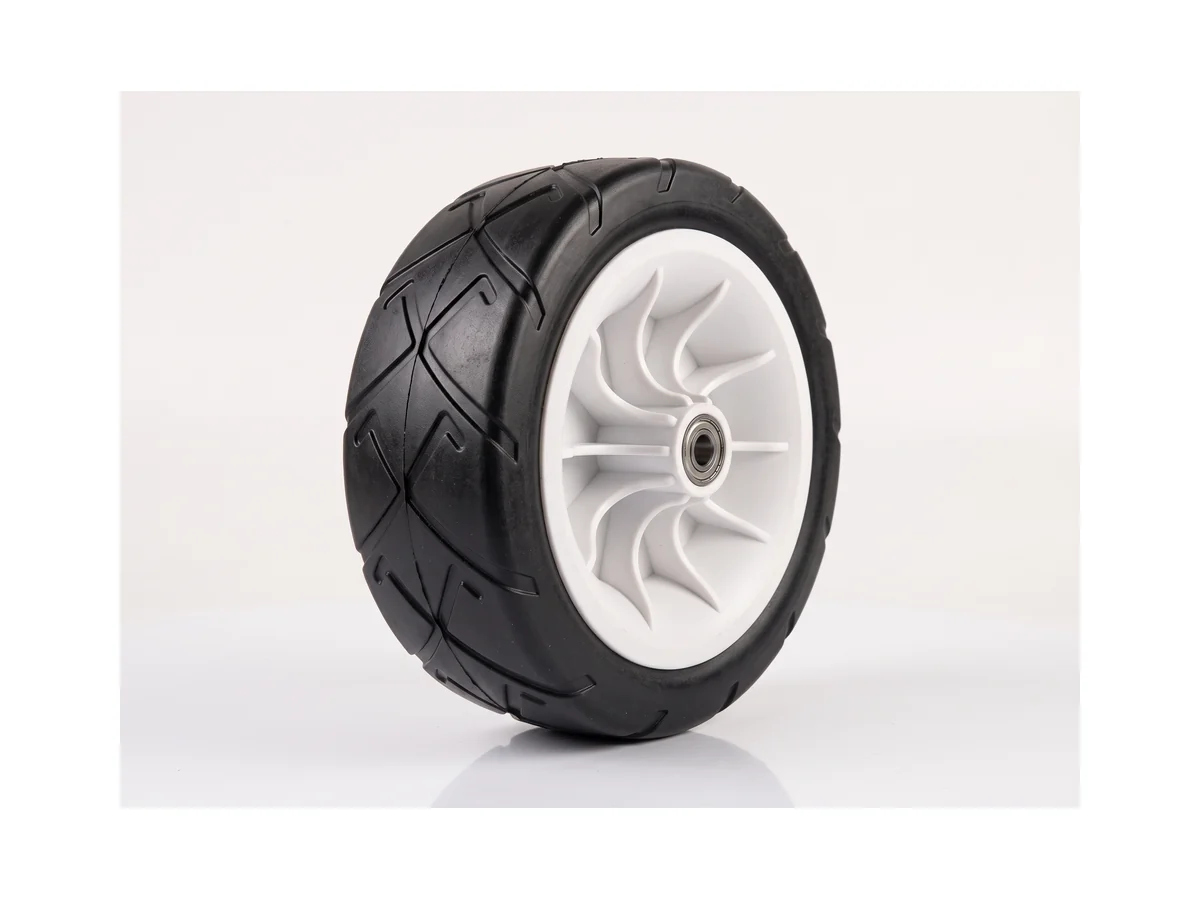
PU foam and pneumatic wheels can look similar from a distance, but they behave differently in daily use. The right choice depends on whether the buyer values ride comfort, zero puncture downtime, maintenance simplicity, or performance on uneven ground.
How the two wheel types work
A pneumatic wheel uses compressed air inside a tire and tube or tubeless assembly. The air chamber deforms when the wheel passes over a bump, which helps absorb vibration and reduces shock transferred to the cart and operator.
A PU foam wheel uses a solid cellular polyurethane filling instead of compressed air. It is designed to provide some cushioning while removing the risk of air loss. Because there is no air pressure to maintain, the wheel can remain operational after contact with nails, sharp debris, or rough jobsite surfaces.
Main differences
| Buying factor | PU foam wheel | Pneumatic wheel |
|---|---|---|
| Puncture risk | No air puncture | Can puncture or lose pressure |
| Maintenance | No inflation check | Pressure should be checked |
| Ride comfort | Moderate cushioning | Usually the softest ride |
| Rolling feel | Consistent | Changes with tire pressure |
| Rough ground | Suitable for many utility uses | Often preferred for maximum shock absorption |
| Downtime control | Strong advantage | Repairs may be needed |
When a PU foam wheel makes sense
PU foam wheels are practical for warehouses, construction areas, gardens, rental fleets, municipal work, and equipment that must remain available without regular tire maintenance. They are especially useful where sharp debris is common or where operators may not check air pressure before use.
Buyers should still confirm wheel diameter, tread width, hub length, bearing or bore arrangement, axle size, and expected load. "Flat-free" does not mean that every wheel has the same load performance or rolling resistance.
When a pneumatic wheel is the better choice
Pneumatic wheels remain a strong option when ride quality is the primary concern. Correctly inflated tires can absorb irregular ground conditions and may make a loaded wheelbarrow or trolley easier to control. They are widely used on wheelbarrows, garden carts, hand trolleys, and other equipment that travels across gravel, soil, or uneven outdoor surfaces.
The tradeoff is maintenance. Low pressure increases rolling resistance and can damage the tire or tube. Buyers should consider access to replacement tubes, inflation practices, and the cost of downtime.
Questions to answer before sourcing
- What equipment will use the wheel?
- What is the expected load per wheel?
- Will the wheel run indoors, outdoors, or both?
- Is puncture debris common in the working area?
- Is maximum cushioning more important than maintenance-free operation?
- What axle, bore, bearing, hub length, and wheel dimensions are required?
Practical conclusion
Choose a PU foam wheel when puncture prevention and predictable maintenance are the priority. Choose a pneumatic wheel when maximum cushioning and performance on uneven ground matter more, and regular pressure checks are acceptable. For a quotation, provide the equipment type, wheel size, hub and axle details, expected load, application surface, and target quantity.
FAQ
Is a PU foam wheel completely solid?
It contains cellular polyurethane rather than compressed air. Construction varies by product, so confirm the wheel specification instead of assuming all flat-free wheels are identical.
Can a PU foam wheel replace a pneumatic wheel directly?
Sometimes, but dimensions and fit must be checked. Diameter, width, hub length, bore, bearings, axle size, load, and clearance all matter.