
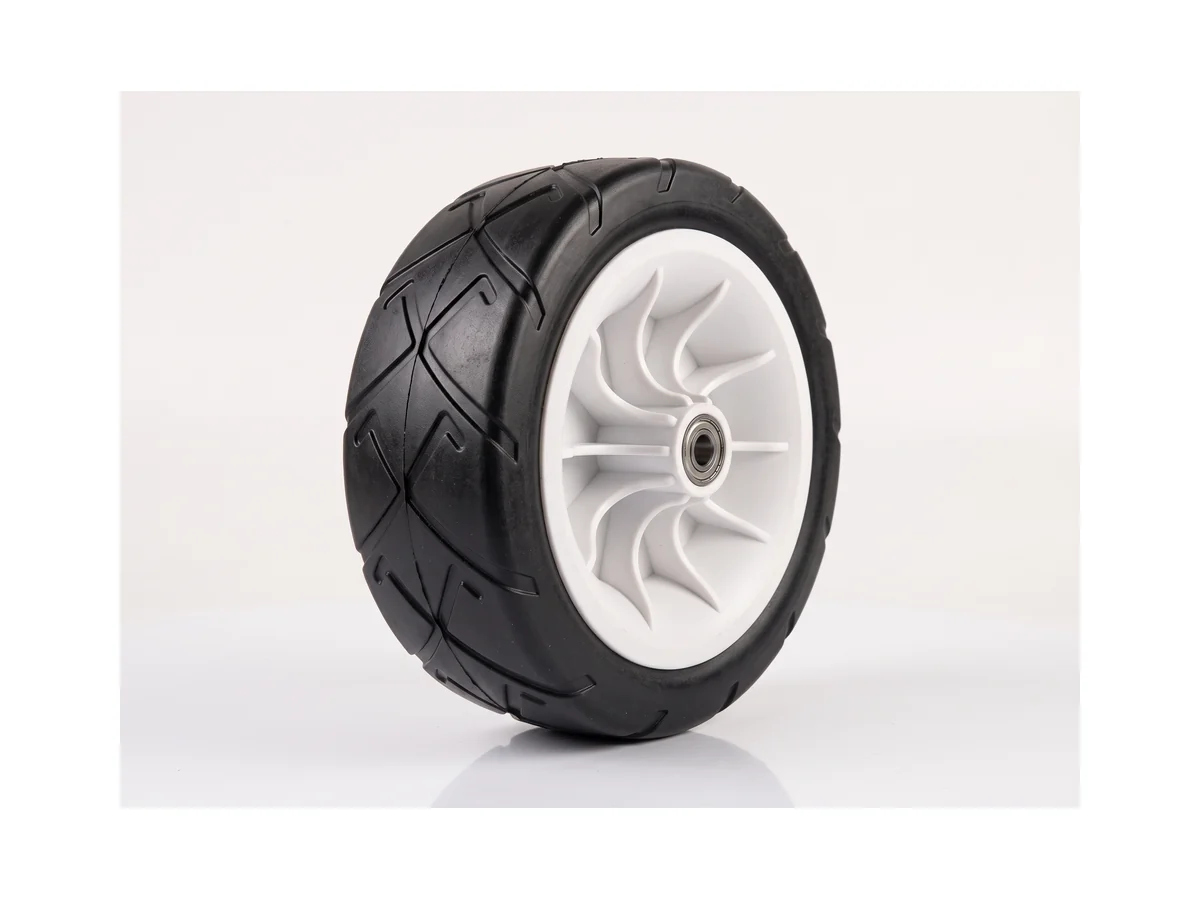
A PU foam wheel is designed to provide puncture-free operation while retaining more cushioning than a hard solid wheel. For importers, distributors, wheelbarrow brands, and equipment manufacturers, the sourcing decision involves more than matching the outside diameter. Tire width, hub length, bore, bearing arrangement, load requirement, tread, color, and axle fit all affect whether a wheel works correctly on the final product.
When evaluating a PU foam wheel manufacturer, buyers should send a complete dimensional and application specification. This guide explains the information needed for wholesale purchasing and OEM development, and where PU foam wheels differ from pneumatic and other flat-free alternatives.
View Kaihang's current PU Foam Wheels range or request product information for a model review.
What is a PU foam wheel?
A PU foam wheel normally uses a microcellular polyurethane tire that does not depend on compressed air. Because there is no inflatable tube, nails and sharp debris do not create the same puncture downtime associated with an air-filled tire. The material can still deform under load, giving the wheel a different ride from rigid plastic or very hard solid rubber constructions.
PU foam wheels are often described as flat-free or puncture proof wheels. These terms describe the absence of inflation failure; they do not mean every wheel has the same load capacity, rolling resistance, rebound, tread life, or temperature performance. The complete wheel assembly must be evaluated against its intended equipment and operating conditions.
Typical applications include wheelbarrows, garden carts, hand trolleys, utility equipment, compressors, generators, and other low-speed mobile products. Buyers looking for a wheelbarrow foam wheel should confirm tray load, axle arrangement, route surface, and required wheel clearance before choosing a model.
Size selection: more than outside diameter
Wheel sizes may be written in inch-based or metric formats, but a nominal label is not enough to confirm interchangeability. Two wheels with a similar outside diameter can have different widths, hub lengths, bores, bearing positions, offsets, and tread profiles.
Outside diameter and tire width
Outside diameter affects ground clearance, rolling behavior, and the position of the equipment frame. Tire width influences contact area and clearance around brackets or forks. Record actual dimensions from the approved drawing or physical sample rather than relying only on a familiar market description.
Hub length and axle fit
Hub length must match the mounting arrangement. A hub that is too long may not fit between frame supports, while a short hub may require spacers or create lateral movement. Confirm whether the dimension includes protruding bearings and whether the wheel is centered or offset.
Bore and bearing arrangement
Specify the axle diameter and whether the design uses a plain bore, sleeve, bushing, ball bearing, roller bearing, or another arrangement. Bearing selection affects installation, rolling feel, maintenance, and cost. The buyer should also identify any required dust protection, spacers, washers, or end caps.
For equipment that still requires air cushioning, compare the Pneumatic Wheels category. For other non-pneumatic constructions, review PU Flat-Free Wheels.
Hubs, rims, tread and appearance
A PU tire can be combined with different hub and rim constructions depending on the model. Common variables include steel or molded hubs, bearing seats, hub color, tire color, tread geometry, and surface finish. These choices should be connected to function and assembly, not selected only from photographs.
Tread affects appearance, soil release, grip, and rolling noise, but performance also depends on material and wheel geometry. A deep tread is not automatically better for every application. Smooth warehouse floors, garden paths, gravel, and mixed outdoor routes create different priorities.
For private-label or OEM PU wheel programs, provide color references, branding artwork, label requirements, packaging format, and any visual acceptance standards. Color matching should be approved using a physical sample or agreed reference because screens and catalog images are not reliable production standards.
How to define load capacity
Load capacity should be discussed per wheel and for the complete equipment. State the working load, number of wheels, load distribution, speed, duty cycle, surface, temperature, and expected impact. A four-wheel cart carrying 200 kg does not always apply exactly 50 kg to each wheel; turns, uneven floors, and an off-center load can increase demand on one wheel.
Ask how the proposed wheel is evaluated and whether the quoted figure is a static or working recommendation. The equipment frame, axle, bearings, fasteners, and number of wheels must also support the intended load. A wheel rating cannot compensate for a weak mounting structure.
Sample testing should use representative equipment and cargo. Observe starting effort, steering, stability, clearance, deformation, noise, and wheel temperature over the actual route. For a replacement wheel for a wheelbarrow, confirm that the loaded tray remains balanced and that the tire does not contact the frame.
PU foam versus pneumatic wheels
Pneumatic wheels generally offer stronger shock absorption because compressed air responds to uneven surfaces. They can be a good choice where operator comfort, cargo protection, or rough-ground cushioning is the main priority. They also require pressure maintenance and can be punctured.
PU foam wheels remove inflation checks and puncture repair. Their ride, starting effort, and deformation depend on the foam formulation and construction. Buyers should compare samples under the same load rather than assuming a flat-free wheel will feel identical to an inflated tire.
The detailed comparison in PU Foam Wheel vs Pneumatic Wheel can help procurement teams document the tradeoffs.
Wholesale sourcing requirements
For PU foam wheels wholesale purchasing, a useful RFQ contains:
- Application and equipment type
- Outside diameter and tire width
- Hub length, bore, bearing, and axle dimensions
- Required working load per wheel
- Surface, speed, duty cycle, and temperature
- Tread and color requirements
- Estimated order quantity and annual demand
- Branding, label, carton, and pallet requirements
- Destination country and applicable compliance responsibilities
- Drawing, reference sample, or current wheel photographs
This information helps a PU foam wheel supplier in China identify an existing model or determine whether an OEM change requires engineering review and tooling.
OEM PU wheel options
OEM options may include an existing wheel with selected color, bearing, hub, branding, or packaging changes. More substantial projects can involve a revised hub, tread, mounting interface, or molded component. Any change affecting tooling, structure, load, or assembly must be reviewed as a development project rather than treated as a simple catalog selection.
Kaihang supports approved projects through OEM and ODM custom manufacturing, including injection molding and in-house mold development where a custom molded component is required. CNC equipment is used internally for injection mold manufacturing; it is not presented as a standalone CNC parts service.
Before tooling approval, confirm drawing revision, ownership, sample stages, acceptance criteria, material, color, bearing specification, packaging, and forecast volume. A controlled specification prevents a visually similar wheel from being approved with the wrong hub or axle fit.
Quality checks before shipment
Quality planning should reflect the agreed product and application. Depending on the model, checks may include dimensions, hub and bore fit, bearing rotation, tire appearance, tread, color, assembly, packaging, and sample-based load or rolling review. Buyers should identify critical dimensions and functional conditions in the purchase specification.
For repeat orders, keep an approved sample and revision-controlled drawing. If the axle, frame, or equipment design changes, review compatibility again instead of assuming the previous wheel remains suitable.
FAQ
Are PU foam wheels completely puncture proof?
They do not rely on an air chamber, so a normal puncture does not cause inflation loss. The tire and wheel can still be cut, worn, overloaded, chemically attacked, or mechanically damaged. Puncture-free operation is not the same as unlimited service life.
Can a PU foam wheel replace a pneumatic wheel directly?
Sometimes, but only after confirming outside diameter, width, hub length, bore, bearing, axle fit, clearance, load, and ride requirements. The equipment may feel different because the two tire constructions respond differently under load.
What information is needed for a wholesale quotation?
Send the model or dimensions, application, load, axle and hub details, quantity, destination, color, branding, and packaging requirements. A drawing or physical sample reduces uncertainty.
Can Kaihang develop an OEM PU wheel?
Kaihang can review OEM requirements based on a drawing, sample, or application specification. Feasibility, tooling, material, test requirements, quantity, and commercial terms must be confirmed before development.
How should buyers approve a sample?
Check the sample on the intended equipment with a representative load. Record dimensions, fit, rolling behavior, appearance, bearing arrangement, color, and any agreed functional tests. Approval should reference a drawing or controlled specification.
Request a PU foam wheel quotation
Send Kaihang the wheel dimensions, hub and bearing requirements, application, working load, quantity, destination, and OEM or packaging needs through the Request a Quote page.
For a faster initial discussion, contact Kaihang on WhatsApp.