

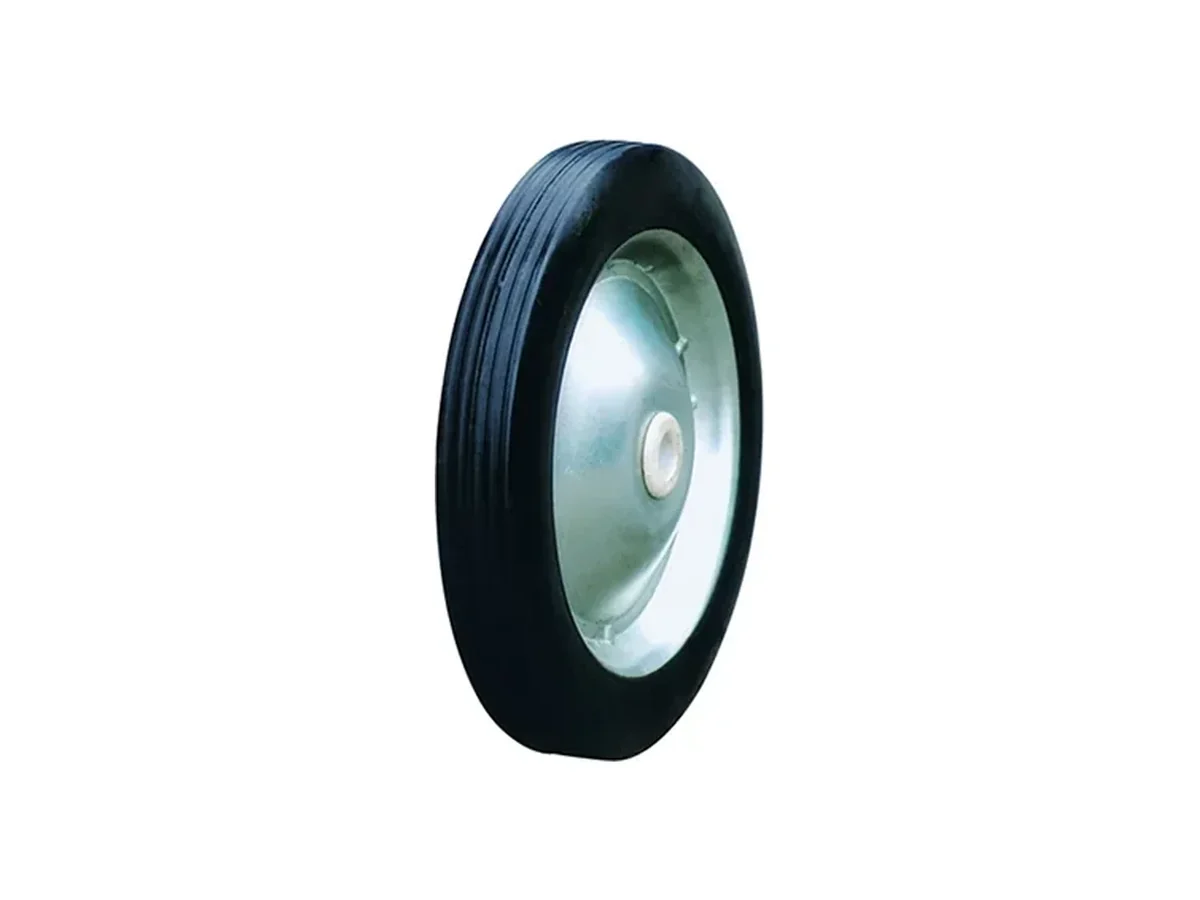
Pneumatic and solid rubber wheels solve different operating problems. Pneumatic tires prioritize cushioning. Solid rubber tires prioritize simple, puncture-free operation. Buyers should compare the working surface, load, speed, downtime risk, and operator comfort before choosing.
Construction and ride
A pneumatic tire contains compressed air. The air chamber flexes under load and absorbs impact, which can protect the load and reduce vibration at the handles. Tire pressure directly affects rolling resistance, stability, and load behavior.
A solid rubber wheel has no inflation chamber. The tire cannot go flat from a puncture, but it deforms less and transfers more shock from uneven surfaces.
Maintenance and downtime
Pneumatic wheels need pressure checks and may require tube, valve, or tire repair. A correctly maintained pneumatic wheel can roll well; an underinflated tire can feel heavy and may be damaged.
Solid wheels remove inflation maintenance. They are useful in facilities where equipment must remain available and surfaces contain debris. Bearings, hubs, and tread still require normal inspection.
Surface and application
Pneumatic wheels are often selected for wheelbarrows, garden carts, hand trolleys, and equipment crossing gravel or soil. Solid rubber wheels are common on industrial carts, trolleys, and utility equipment operating at low speed on firm surfaces.
Neither description replaces a specification review. Tire compound, tread, wheel diameter, hub, bearing, and load design influence real performance.
Selection questions
- Is cushioning important for the load or operator?
- Are nails, metal chips, or sharp debris common?
- Will operators maintain tire pressure?
- What is the required load per wheel?
- What are the speed, duty cycle, and surface conditions?
- What hub, bearing, bore, and axle arrangement is required?
Cost should include operation
Unit price is only one part of buying cost. Consider repair labor, replacement parts, downtime, operator effort, and service life in the actual environment. A pneumatic wheel may justify maintenance through better ride quality. A solid wheel may justify a different rolling feel by eliminating puncture downtime.
FAQ
Which wheel carries more load?
Load depends on the specific wheel design, not only on whether the tire is pneumatic or solid. Compare verified model specifications.
Can I change tire type without changing the wheel size?
Possibly, but confirm overall diameter, width, hub, bore, bearings, axle, clearance, and load. Nominal size alone is insufficient.
How should samples be compared?
Compare candidate wheels on the intended equipment with the same representative load. Observe starting effort, steering, vibration, noise, stability, clearance, and behavior over floor joints or outdoor terrain. For a pneumatic wheel, record the tire pressure during the comparison; an underinflated sample does not provide a fair basis. For a solid wheel, make sure the tread compound and hub arrangement match the proposed production specification.
Procurement teams should retain more than a visual approval. Record overall dimensions, hub length, bore or bearing, tread, tire construction, color, load requirement, and application. If downtime from punctures is the main concern, say so in the RFQ. If cushioning and operator comfort dominate, state the route and surface conditions. This lets the supplier recommend a construction against the real operating priority instead of treating every wheel of the same diameter as interchangeable.