

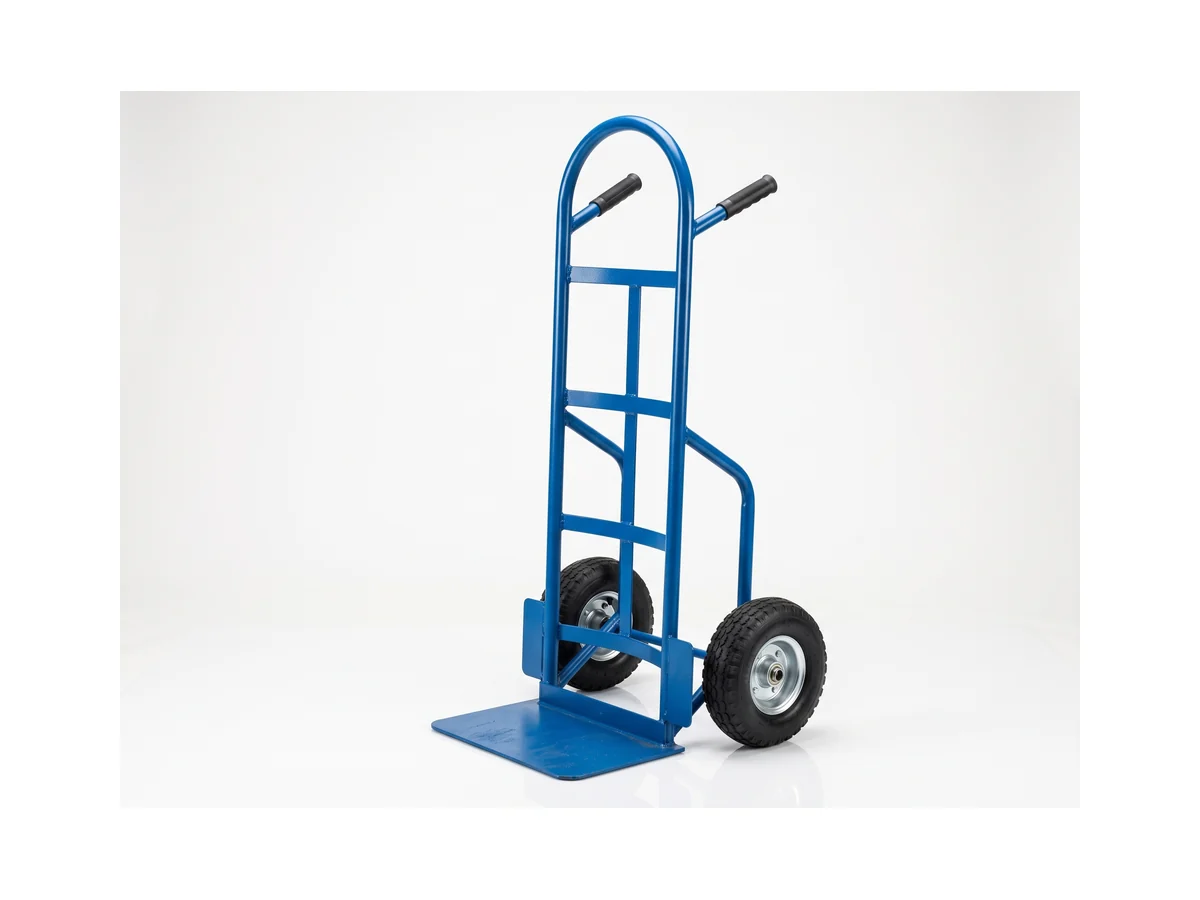
A hand trolley should be selected around the load, route, operator, and working environment. A high headline capacity does not guarantee that the trolley is convenient, stable, or suitable for the items being moved.
Define the load
Record the typical and maximum load, package dimensions, center of gravity, and whether the items are rigid, fragile, loose, or cylindrical. A tall load may need a taller frame or support straps. Wide packages may require a wider toe plate or platform.
Avoid treating rated capacity as the only buying criterion. Frame geometry, welds, axle, wheels, bearings, and the way the load sits on the trolley all matter.
Map the travel route
Check floor condition, slopes, thresholds, door widths, elevators, loading areas, and any outdoor sections. Large pneumatic or foam wheels can help on uneven ground. Smaller solid or castor wheels may suit smooth warehouse floors and compact storage.
If stairs are involved, use a design intended for that task rather than assuming a standard trolley can be used safely.
Compare trolley formats
Two-wheel hand trolley
Useful for boxes, sacks, appliances, and vertical loads. Review toe plate size, handle style, frame height, and wheel position.
Platform hand truck
Provides a horizontal deck for multiple cartons or stable loads. Check platform dimensions, castor arrangement, steering behavior, and handle configuration.
Convertible trolley
Can change between upright and platform modes. Confirm locking points, changeover method, and capacity in each configuration.
Wheel selection
Wheel diameter, tread, hub, bearing, and tire construction affect starting effort, noise, vibration, and maneuverability. Match the wheel to floor condition and puncture exposure. For platform trucks, castor layout controls turning radius and directional stability.
Sourcing information
Provide load range, cargo dimensions, route conditions, preferred trolley format, wheel requirements, platform or toe dimensions, finish, packing, quantity, and destination market. For private-label programs, state branding and packaging needs early so they can be reviewed with product and order requirements.
FAQ
Should I choose the highest possible capacity?
Not automatically. Overspecification can add weight and cost. Select a suitable margin over the real operating load and confirm the complete trolley design.
What finish is suitable?
Finish depends on the environment and product design. Powder coating is common for steel frames. Discuss surface and corrosion-related requirements with the supplier instead of assuming one finish fits every environment.
What should be checked on a product sample?
Load the sample with representative cargo rather than judging it empty. Check whether the toe plate or platform supports the package, whether the handle provides a comfortable working position, and whether the frame stays stable during starting, stopping, and turning. Roll it over the actual thresholds and floor joints likely to be encountered. Wheel clearance, fasteners, axle retention, weld appearance, folding or locking functions, and packaging should also be reviewed.
What should an RFQ include?
A useful hand-trolley inquiry states the trolley format, typical and maximum load, cargo dimensions, floor and route conditions, required platform or toe size, wheel preference, quantity, destination, branding, and packing expectations. If a buyer is replacing an existing model, photographs and the dimensions that worked or failed can be more informative than a general product name. This allows the supplier to compare available models without presenting an unsuitable high-capacity trolley as the automatic answer.